


What small B2B teams can achieve with CRM, AI agents and automation – and where the limits are....

Why I want to rethink CRM and GTM operations in the age of AI, what a Customer Intelligence Management system could look like, and why I'm looking for companies that want to build it with me.
Over the past few months, I have increasingly started to question some of my previous approaches to designing CRM systems and go-to-market operations.
Not because these approaches were fundamentally wrong. Many of them made perfect sense given the technological conditions at the time.
But advances in AI assistants, automated research and the processing of unstructured data now open up possibilities that, just a few years ago, would only have been feasible with considerable technical and financial effort.
Why should we keep asking employees to fill in countless CRM properties manually when the relevant information is already contained in their customer conversations and emails?
Why should we keep asking prospects the same questions when we may already know the answers?
Why should we define the same qualification requirements for a prospect with low revenue potential as for a strategically important key account?
And why should valuable customer knowledge be lost when a buying initiative fails, when a customer is handed over between departments, or when an employee leaves the company?
These and other questions led me to develop a concept I call Customer Intelligence Management.
I have not yet implemented a complete system based on this concept for any client. However, individual components of it have been part of my work for years. What is new is the possibility of using AI to combine these components into a far more automated, adaptive system that spans the entire customer lifecycle.
In this article, I want to show what such a system could look like, which business problems it is meant to solve, and why I believe it is worth rethinking CRM implementations today.
01
What should a company actually know about its customers?
When designing a CRM system, we often focus on data models, properties, lifecycle stages, pipelines, automations and integrations.
I'd like to start one step earlier.
Which business questions should a company be able to answer about its prospects and existing customers? Which decisions does it want to make based on those answers? And what information does it need to do so?
Let's start with acquiring a new B2B customer.
Even before a company is contacted for the first time, some fundamental questions arise:
- Do we have sufficiently reliable information to segment and qualify the company?
- Does the company operate in an industry we serve?
- Are our products or services potentially relevant to the company?
- What is the short- and long-term revenue potential?
- Is a technical integration of our solution possible in principle?
- Is personal outreach worthwhile, or should we take a largely automated approach?
- Should we approach the company directly or through one of our sales partners?
As the sales process progresses, further questions come up:
- Does the company have a relevant problem that we can solve?
- Is it aware of this problem, and how high a priority is solving it?
- Is it already looking for a solution?
- Could concrete buying interest emerge in the next few months, or only in a few years?
- Which solution does the company currently use, and how satisfied is it with it?
- Which business outcomes does it want to achieve?
- Whom do we need to convince inside and, if applicable, outside the company?
- Which decision criteria will be applied?
- Is there a budget, and has it already been approved?
- Do we have to compete against other vendors, an in-house build or the status quo?
- Which technical and organizational requirements must be met?
Even during proposal and contract negotiation, the selling company still has to make decisions:
- Given the new insights, does the deal still make economic sense?
- Do we need to increase or reduce our sales effort?
- Do we need support from additional colleagues or partners?
- Can we offer a standard solution, or is extensive customization required?
- Are the customer's expectations realistic?
- Can we deliver the requested services within the required timeline?
- Is the deal still profitable under the final terms?
Of course, the need for information doesn't end when the contract is signed.
During onboarding, ongoing account management and customer growth, further questions arise.
Is the customer using our solution successfully? Is it achieving the desired business outcomes? Have its requirements changed? Are there signs of an upcoming cancellation? Is there potential for additional products or services? Have relevant stakeholders or strategic priorities changed?
The list could go on for quite a while.
For me, these business questions should be the starting point for designing a CRM system and professional GTM operations.
Only then should we turn to how we obtain, manage and use the information required.
02
Not every company needs to know the same amount about every customer
That said, it would be neither economical nor necessary to answer all of these questions for every prospect.
Many B2B companies serve different customer segments and pursue correspondingly different go-to-market motions.
A SaaS company might, for example, acquire smaller companies through a fully automated self-service process, mid-sized companies with selective support from sales, and larger companies through a personal, consultative sales process.
The information required differs considerably in each case.
For a prospect with an expected deal value of 500 euros, for example, it would hardly make sense to research every decision-maker, their individual interests and the internal purchasing processes.
For a potential deal worth 250,000 euros, on the other hand, the same information could be extremely valuable.
Every additional piece of information potentially comes at a cost: research, employee time, AI and automation costs, data maintenance and added complexity in the CRM system.
The effort on the customer's side shouldn't be underestimated either. An unnecessarily extensive qualification process can put prospects off and hurt conversion rates.
I would therefore establish three principles:
Minimum Viable Customer Intelligence: Initially, obtain only the information needed for the next meaningful business decision.
Progressive Customer Intelligence: Build additional customer knowledge as soon as the customer's potential or the progress of the relationship justifies it.
Just-in-time Validation: Update or confirm information when it is needed for a relevant decision.
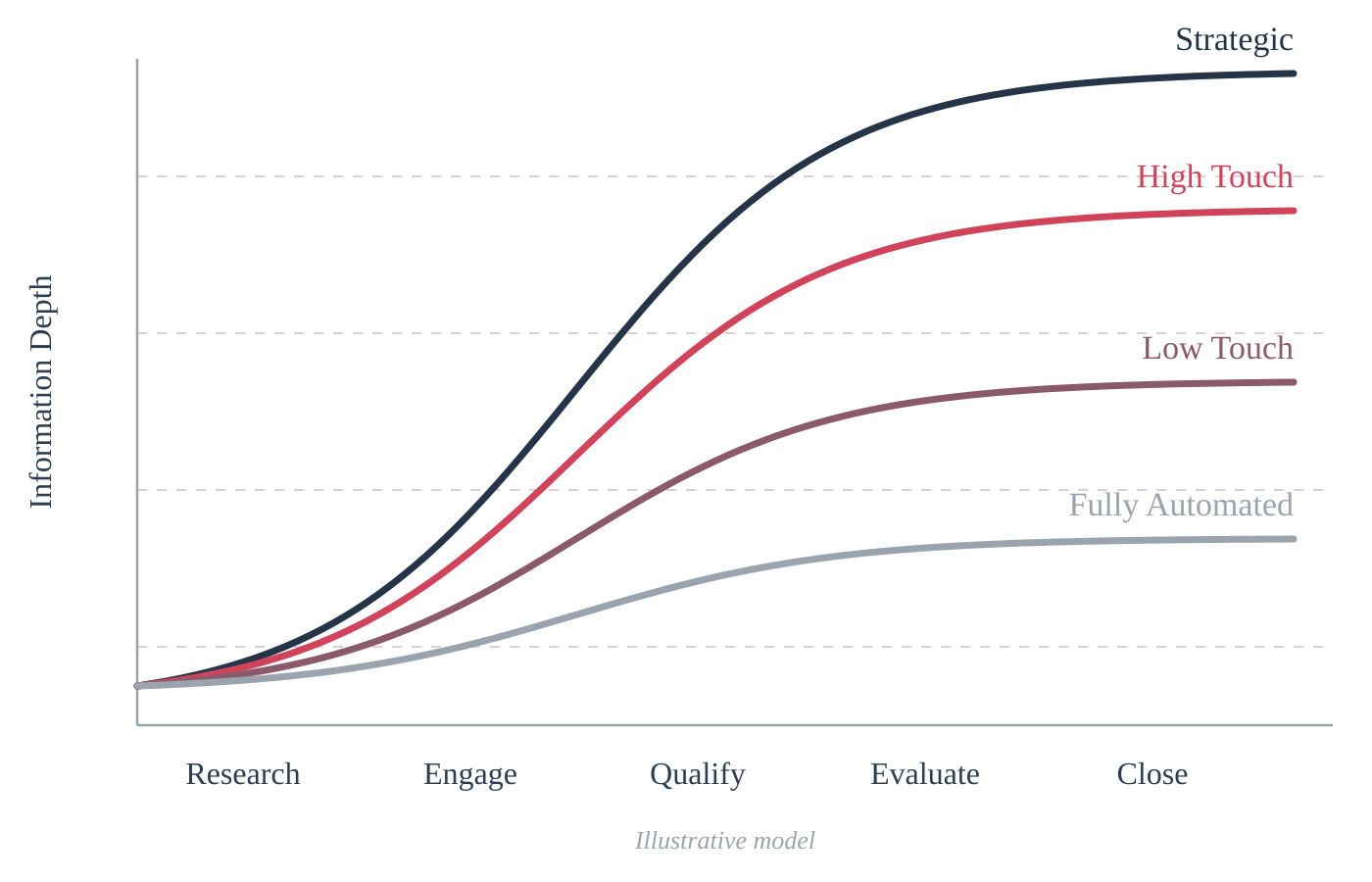
Progressive Customer Intelligence: the depth of information required grows with customer potential and the progress of the relationship.
The go-to-market motion itself should also be dynamic.
A company originally earmarked for a largely automated approach could suddenly become interesting for personal outreach because of an acquisition, a funding round, a new strategic project or other developments.
Conversely, it might make sense to reduce personal sales effort if a planned purchase is postponed by several years.
The customer knowledge already built up should not be lost in the process.
03
Customer knowledge should outlast individual buying initiatives
Much of the knowledge a company builds up while acquiring a customer could still be valuable years later.
Imagine your sales team invests several months in pursuing a potential key account.
In numerous conversations, your team learns a great deal about the company's business model, organizational structure, technology infrastructure, business challenges, internal decision processes and expectations.
In the end, however, the company decides against buying your solution. Perhaps there is no budget, perhaps it is still contractually bound to another vendor, or the project simply isn't given enough internal priority.
Two years later, a new buying opportunity arises.
How much of the knowledge built up back then is still available to your team? How much of it can they reuse right away? And do they know which information may now be outdated?
Ideally, the sales process wouldn't have to start from scratch.
At the same time, earlier insights shouldn't be adopted uncritically as current facts.
I would therefore distinguish customer information by how long it stays valid.
A piece of information can lose its current decision value without losing its historical value.
If a company decided against your solution in 2026 because of a missing technical capability, that insight can still be valuable in 2028. Whether the capability is still needed, and whether your solution now offers it, will have to be checked again.
For particularly decision-relevant insights, other aspects should therefore be considered alongside the content itself:
- Where does the information come from?
- When was it captured or last confirmed?
- Is it a fact, a customer statement, an estimate or a hypothesis?
- How reliable is it?
- How likely is it to have changed in the meantime?
- Does it need to be validated again before the next business decision?
Of course, this doesn't mean all information should be stored indefinitely. Data protection, purpose limitation and sensible retention periods must be part of the concept.
What matters is that customer knowledge isn't built solely for a single process or a single buying initiative, but can be reused across the entire customer lifecycle wherever this is sensible and permissible.
04
Employees should no longer be the primary interface for CRM data entry
In my experience, one of the biggest challenges in CRM implementations is balancing the company's information requirements against the administrative burden on its employees.
Marketing, sales, customer success and management need reliable information to do their jobs well.
At the same time, customer-facing employees want to spend their time with customers, not maintaining countless CRM properties.
In the past, we tried to solve this problem with required fields, standardized playbooks, structured call guides, training and automation, among other things.
That made sense, and in part it still does.
However, much of the customer knowledge needed is already created in employees' day-to-day work:
- in personal emails,
- in phone calls and online meetings,
- in support requests and service conversations,
- in in-person customer meetings,
- in proposals and contract negotiations,
- when jointly planning implementations and future projects.
Further information emerges independently of personal customer interactions, for example through website visits, product usage, marketing campaigns or publicly available company information.
Why should employees have to enter information into a CRM system manually when it already exists in these sources?
Going forward, I would prioritize information capture in the following order:
- Passive Data Capture: Automatically capturing information that arises anyway in daily work or through customer interactions.
- Automated Research: Automatically obtaining relevant information from internal and external sources.
- Automated Knowledge Extraction: AI-powered extraction of business-relevant insights from emails, call transcripts and other unstructured data.
- Conversational Data Entry: Passing additional insights to the CRM in natural language, for example via an AI assistant or by voice.
- Human Validation & Decision: Human review of critical information and the decisions based on it.
- Manual Property Entry: Targeted manual data entry when no more efficient or sufficiently reliable method is available.
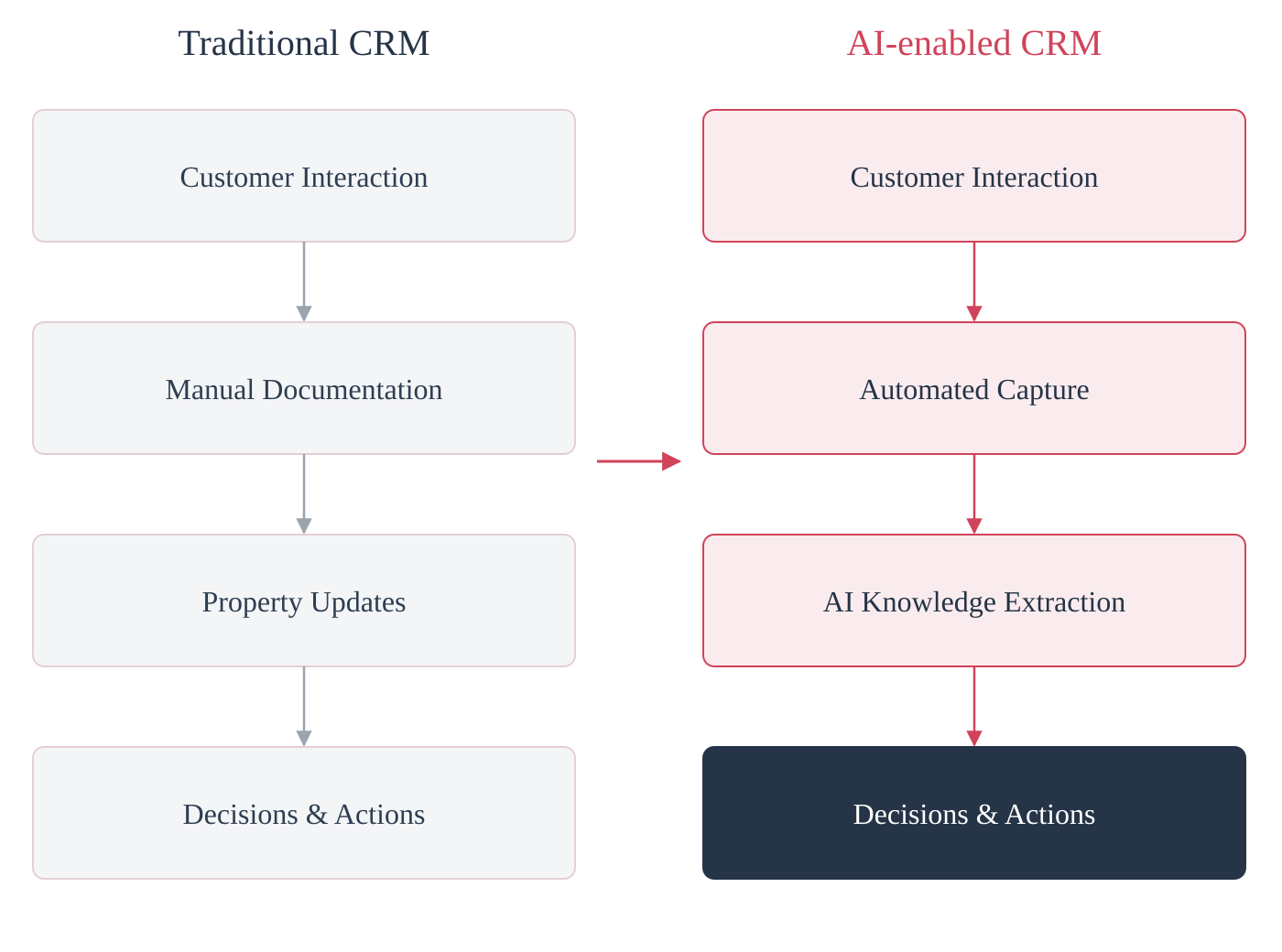
From manual documentation to automated capture and AI-powered knowledge extraction.
After an in-person customer meeting, an employee could, for example, tell their AI assistant:
“I just spoke with the managing director. The company is planning to expand into Germany next year, but the funding isn't secured yet. He wants us to get back in touch in March. For the technical evaluation, we should then talk to his CTO.”
A suitably configured system could extract strategic company goals, current buying obstacles, relevant stakeholders and a future contact date from this, assign the insights to the right company and buying initiative, and prepare the corresponding follow-up actions.
The employee wouldn't have to think about which CRM objects and properties this information should be stored in.
The complexity of the CRM data model should have as little impact as possible on the complexity of its users' daily work.
In my view, this could make a significant contribution to more successful CRM adoption.
05
Do we still need classic CRM playbooks in the age of AI?
In this context, I would also question the traditional role of playbooks.
Classic playbooks, such as those offered by HubSpot, help companies standardize customer interactions, ask relevant questions and capture the answers in the CRM in a structured way.
However, a static call guide takes only limited account of what a company already knows about a prospect.
A discovery call with a company you've known for five years may call for different questions than one with a company you've never been in contact with before.
Going forward, I would therefore distinguish more clearly between three things:
Business Knowledge Requirements: What insights does the company need to make certain business decisions?
Human Playbooks: How should employees shape customer interactions, communicate, advise and make decisions?
AI Skills: How should an AI assistant analyze existing customer knowledge, identify missing information, prepare conversations, extract insights and update the CRM?
Instead of giving an employee a largely static list of questions, an AI assistant could prepare an individual briefing before a customer conversation:
- What do we already know about the company?
- Which information may be outdated?
- Which business-relevant questions are still unanswered?
- Which insights from previous buying initiatives should be taken into account?
- Given the customer's potential and the current progress of the deal, what should we find out in this conversation?
During the conversation, the employee could focus largely on interacting with the customer.
Afterwards – provided a permissible recording or transcript is available – the AI could extract the new insights, compare them with existing knowledge and suggest corresponding updates and next steps.
Classic playbooks could continue to play an important role in onboarding new employees, sharing best practices or ensuring certain compliance requirements.
In my view, however, their role as the primary instrument for structured CRM data capture is likely to diminish.
We should no longer define only which questions employees must ask, but above all which insights our company needs.
06
Does every business-relevant piece of information need to be stored in a CRM property?
Traditional CRM automations and reports depend heavily on structured data.
If a company wants to trigger different processes based on a lead's industry, company size or purchase readiness, for example, that information has to be available in a machine-readable form.
AI won't fundamentally change that.
However, AI makes it possible to work far more efficiently with unstructured and semi-structured information.
This could allow CRM data models to become simpler without sacrificing relevant customer knowledge.
I envision four interconnected layers of information for this.
Raw Customer Context
The original information and its context: emails, call transcripts, notes, form submissions, website interactions, product usage data and external research results.
Customer Knowledge
Insights extracted and condensed from the original information about companies, people, business challenges, technical requirements and past customer relationships.
Structured Decision Data
The information regularly needed for segmentation, routing, automation, qualification, reporting or other machine-supported decisions.
This should continue to be represented in suitable structured CRM properties, objects and associations.
Decision & Action
Providing relevant information to employees, automations and AI agents in the right situation to support business decisions and trigger the corresponding actions.
A company could, for example, hold a detailed description of a customer's technology infrastructure without needing a separate CRM property for every technology in use.
If, however, a particular technology is regularly relevant for segmentation, product compatibility checks or automated outreach, a structured property for it would certainly make sense.
Assigning information to the right CRM object also remains important.
Long-term company knowledge shouldn't be stored only on individual deals. Conversely, the budget, competitors or specific requirements of a particular buying initiative shouldn't simply be stored on the company as if they were universally valid.
The challenge is finding the right balance between structured data, condensed customer knowledge and the original sources of information.
Not everything a company should know about its customers needs to be mapped to individual CRM properties.
07
How do we keep customer knowledge up to date without incurring unnecessary costs?
Another challenge is keeping existing information up to date.
With AI-powered research, a lot of information can now be obtained automatically. That doesn't mean it would make sense to regularly re-research all information about every company in the CRM.
A company with tens of thousands of prospects could incur considerable and possibly unnecessary research and AI costs this way.
I would combine different update mechanisms.
A system should not only recognize that new information is available, but also judge whether it is relevant to your own business.
A funding round might make concrete buying interest more likely at one company, for example, while having no bearing at all on the relevance of your solution at another.
Customer interactions should also be processed as efficiently as possible.
Instead of many independent AI automations analyzing the same call transcript over and over, it could be more economical to extract the relevant insights once and then make them available for different purposes.
Optimizing research costs, credit and token consumption, context provisioning and model choice is therefore likely to become an important part of professional AI-powered GTM operations.
We don't need to know everything about every customer at all times.
But we should be able to obtain and provide the right information as soon as it's needed.
08
What could a Customer Intelligence Management system look like?
By Customer Intelligence Management, I mean the systematic building, management, updating and situational use of decision-relevant customer knowledge across the entire customer lifecycle.
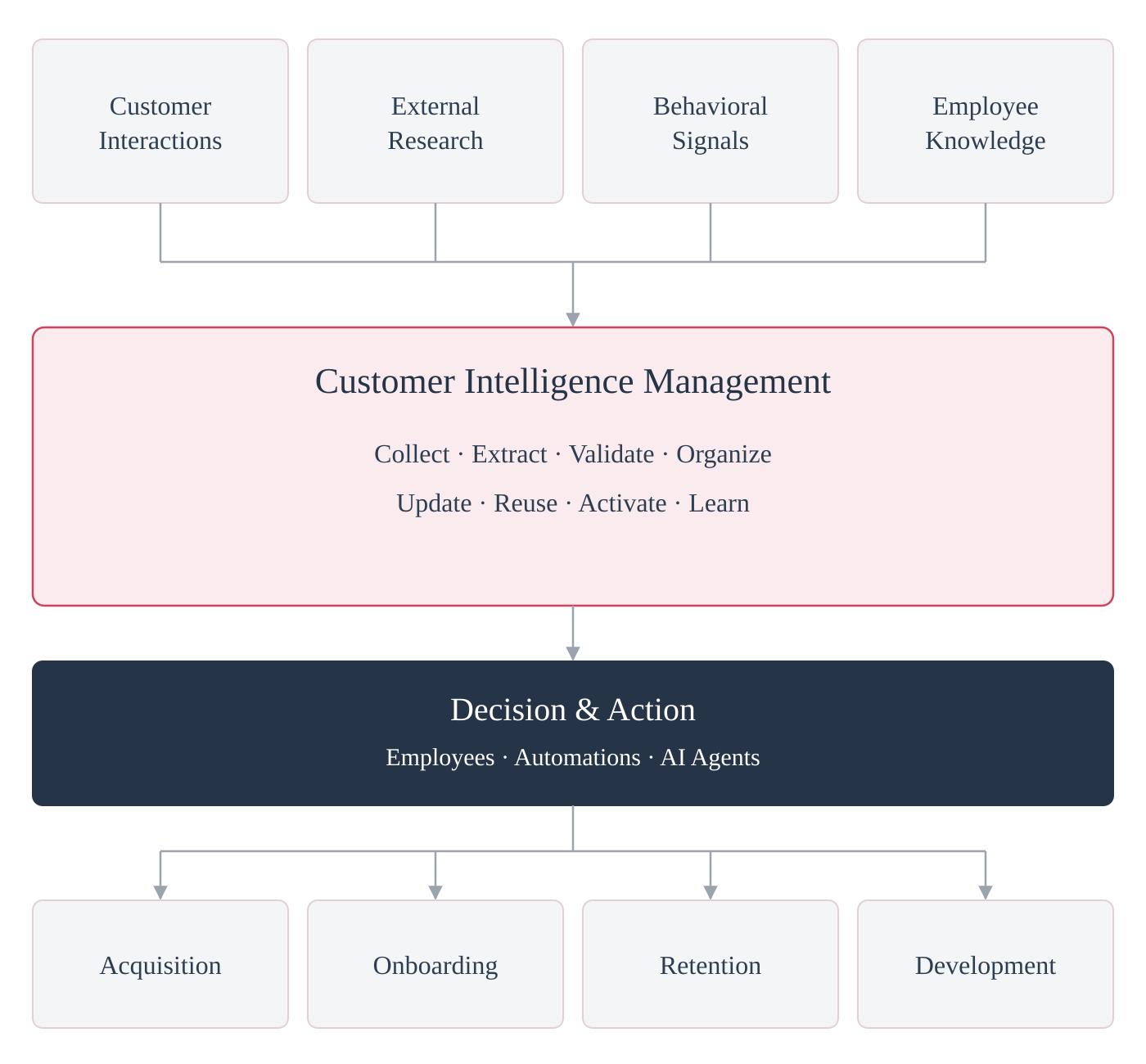
Customer Intelligence Management: bringing together knowledge from all sources and making it usable for decisions across the customer lifecycle.
In my view, such a system should combine several capabilities:
Collect: Capture relevant information as automatically as possible from customer interactions, external sources and connected systems.
Extract: Extract business-relevant insights from structured and unstructured information.
Validate: Take the source, recency and reliability of information into account, identify contradictions and request human review where needed.
Organize: Structure information meaningfully, assign it to the right companies, people and buying initiatives, and preserve historical knowledge.
Update: Update relevant information according to how long it stays valid and its business value.
Reuse: Reuse existing customer knowledge across departments, buying initiatives and lifecycle stages.
Activate: Provide the relevant knowledge to employees, automations and AI agents to support business decisions and actions.
Learn: Review which information and decision logic actually lead to better business outcomes, and evolve the system accordingly.
Such a system should not, however, be built with the aim of fully automating as many decisions as possible.
Depending on the significance of a decision, the quality of the available information and the possible consequences, an employee should review AI-generated insights, confirm a decision or make it themselves.
Permissions, data protection, information security, traceable sources and rules for automatically updating data must also be considered from the outset.
For example, information confirmed by a customer should not be overwritten unchecked by a poorly founded AI assumption.
09
What role could HubSpot play?
As a HubSpot consultant, I'm naturally also exploring to what extent such a system can be built on HubSpot.
HubSpot now offers numerous building blocks that are relevant here.
These include, among others:
Some of these features have been available for quite some time, while others are relatively new or still under development.
Their availability and scope also depend on the respective HubSpot subscription and, in some cases, on the pricing model.
In my view, combining these features opens up interesting possibilities. However, I wouldn't assume that a complete Customer Intelligence Management system can be built simply by switching on a few HubSpot features.
It takes an overarching concept.
A company first has to define which business decisions it wants to support, what information is needed for them, and how that information can be obtained, processed, stored and updated as efficiently as possible.
Then it needs to evaluate which requirements can be met natively in HubSpot and where additional integrations, external AI models or custom-built components make sense.
Using ChatGPT or Claude as the preferred interface for customer-facing employees could also play a role, provided the necessary data access, permissions and actions are in place.
HubSpot could thus form the central CRM and process infrastructure without necessarily being the only interface through which employees interact with customer knowledge.
10
What business value could such a system create?
Customer Intelligence Management shouldn't be a purely technological innovation project.
It should solve concrete business problems and help reduce lost revenue, unnecessary costs and inefficient use of resources across the customer lifecycle.
This could also change how we assess the quality of a CRM system.
I consider the classic data completeness rate – the share of filled-in CRM properties – to be of only limited value.
A low-touch lead with ten filled-in properties could be sufficiently qualified, while a strategically important account could still be missing crucial information despite 50 filled-in properties.
I would therefore focus more on metrics like these:
- Decision-relevant Information Coverage: Is the information needed for upcoming decisions available?
- Information Freshness: Is this information sufficiently up to date?
- Extraction Accuracy: How accurate are automatically extracted insights?
- Automated Capture Rate: What share of relevant information is captured without manual data entry?
- Knowledge Reuse Rate: How often can existing insights be reused?
- CRM Administration Time: How much time do employees spend on manual data entry and maintenance?
- Information Acquisition Cost: How much does it cost to obtain the required information and keep it up to date?
Ultimately, though, the success of such a system must also show in business metrics: for example, lower customer acquisition costs, higher conversion rates, shorter sales cycles, lower churn rates or more profitable customer growth.
Whether and to what extent these improvements can be achieved has to be examined using concrete use cases.
11
What I don't know yet
I already have conceptual ideas on many of these topics and experience with individual building blocks.
However, I have not yet implemented a complete Customer Intelligence Management system as described here for a client.
Accordingly, there are some questions whose answers I don't want to anticipate:
- How reliably can AI assistants extract and update relevant customer knowledge under real-world conditions?
- How much human validation will still be necessary?
- What should the optimal balance between structured and unstructured customer knowledge look like?
- How can access to extensive historical customer interactions be organized efficiently?
- How can research, credit and token costs be optimized sensibly?
- How much can be implemented natively in HubSpot?
- Where are additional technology components needed?
- How will the daily work of customer-facing employees change?
- Which new skills and organizational responsibilities will be required?
- How large is the actual, measurable business value?
So for me, this isn't about selling a supposedly finished system, but about developing an approach further based on real business challenges.
I'm convinced that many companies could build and use their customer knowledge far better than they do today.
I want to find out what the optimal system looks like together with companies that are ready to evolve their existing CRM and GTM operations approaches.
12
Customer Intelligence Design Partner Program
To develop and implement this concept in practice, I'm looking for B2B companies that would like to work with me as design partners.
I'm particularly interested in companies that already use HubSpot and meet some of the following criteria:
- You serve different customer segments and use different sales or account management models.
- You already have a relevant body of customer information and historical customer interactions.
- Several departments are involved in acquiring, serving and growing customers.
- Your employees spend too much time on manual CRM data entry or searching for relevant information.
- Valuable customer knowledge gets lost during handovers, lost deals or staff changes.
- You want to use the potential of AI beyond individual assistant features and isolated automations.
- You're willing to critically question existing processes, data structures and organizational responsibilities.
A complete Customer Intelligence Management system doesn't have to be built right from the start.
Rather, I want to start with concrete, economically relevant use cases and develop the system step by step.
This is how I envision the collaboration:
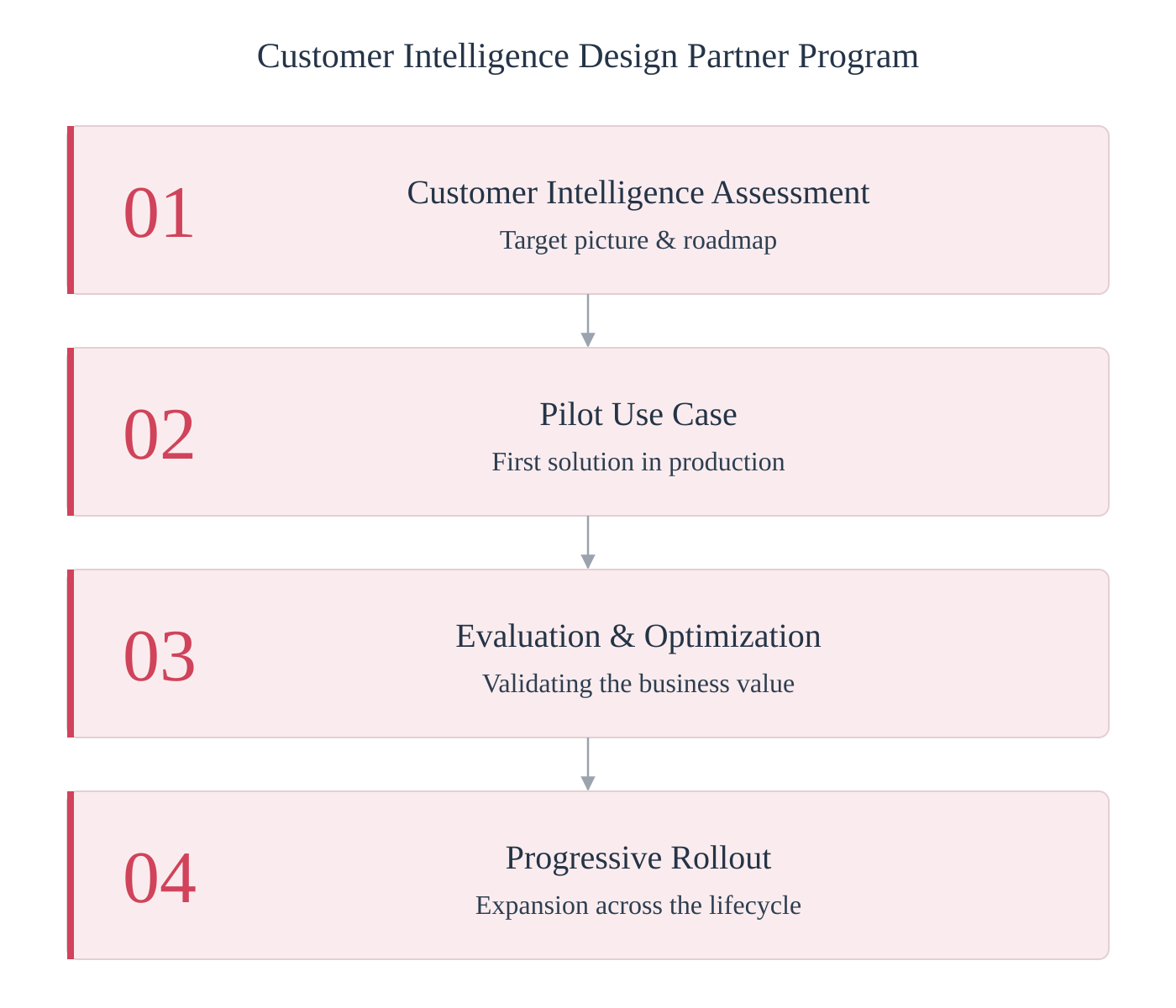
Four phases – each with standalone business value.
Phase 1: Customer Intelligence Assessment
First, we jointly analyze which business decisions your company needs to make across the customer lifecycle and what information is required for them.
Among other things, we look at:
- your customer segments and sales or account management models,
- your existing CRM data structures and processes,
- the available internal and external information sources,
- the current effort for information gathering and CRM data maintenance,
- existing information gaps and information loss,
- the potential for automated data capture and AI-powered knowledge extraction.
On this basis, we develop an initial target picture and identify the use cases where we expect the greatest business value.
Outcome: An individual Customer Intelligence target picture, prioritized use cases and an initial roadmap.
Phase 2: Pilot Use Case
Next, we jointly select a clearly defined use case to implement in practice.
This could be, for example:
- Automatic extraction of decision-relevant insights from customer calls and emails.
- Individual, AI-powered call preparation for sales or customer success teams.
- Automated, needs-based qualification of different lead segments.
- Reusing historical customer knowledge when reactivating lost deals.
- Improving the handover of information between sales and customer success.
- Continuous identification of relevant retention and expansion signals.
We define the requirements, success criteria and constraints, and implement the use case on your existing technology infrastructure.
Outcome: A solution in practical use within your company for a concrete business use case.
Phase 3: Evaluation & Optimization
After implementation, we examine how the solution performs under real-world conditions.
We look at it from a technological as well as a business and organizational perspective.
How reliable are the automatically generated insights? How much manual effort was reduced? What are the ongoing operating costs? How are employees adopting the new way of working? What impact is visible on the relevant business metrics?
Based on these findings, we optimize the solution and decide whether further expansion makes sense.
Outcome: A transparent assessment of the solution, its cost-effectiveness and its further development potential.
Phase 4: Progressive Rollout
If the approach proves itself in the first use case, we can gradually add further information sources, use cases, customer segments, departments and lifecycle stages.
Along the way, we continuously evolve the shared architecture, information standards, AI skills, automations and organizational framework.
The long-term goal is not a patchwork of isolated AI solutions, but a coherent Customer Intelligence Management system aligned with your company's actual business requirements.
Outcome: A gradually growing, integrated and economically focused Customer Intelligence Management system.
What does working together as a design partner mean?
I don't see a design partner as a test customer for an already finished product.
Rather, I want to give companies the opportunity to actively bring their individual requirements and experience into the design and further development of this approach.
In return, I contribute my experience in growth marketing, CRM, marketing automation, GTM operations and HubSpot implementations, and accompany the collaboration from analysis and design through technical implementation to the rollout of new ways of working and the evaluation of results.
The collaboration is intended as a paid consulting and implementation project, with scope, goals and terms defined together.
Each phase is meant to deliver standalone business value. There is no obligation to implement the full system.
Customer Intelligence Design Partner Program
Let's rethink CRM and GTM operations together
I believe we are only just beginning to understand how AI can change CRM systems and customer-facing business processes.
I don't see the biggest opportunity in completing individual existing CRM tasks a little faster.
I see it in fundamentally rethinking how companies build, manage and use customer knowledge, how employees interact with that knowledge, and how business decisions are made and implemented.
If employees spend less time searching for and manually documenting information, if relevant customer knowledge is no longer routinely lost, and if companies can deploy their resources more precisely, this could make a significant contribution to more successful and more economical GTM operations.
I want to find out how far we can already get with the technologies available today.
If you recognize some of the challenges described here and are interested in developing a Customer Intelligence Management system with me and implementing it step by step in your company, I look forward to hearing from you.